
An Internet of Cars

Cassandras Nets Grant to Develop Smart Car Technology

Drivers who commute in and out of Boston — deemed as one of the worst U.S. cities for traffic — have all experienced the misery of rush hour. Now, Professor Christos Cassandras (SE, ECE) is part of a research group aiming to ease commuting, and the resulting air pollution, by developing efficient, smart vehicle technology under a $4.4 million grant from the Energy Department’s Advanced Research Projects Agency-Energy NEXTCAR program.

“Right now, the car’s awareness of its surrounding relies completely on the eyes and ears of the driver operating it,” says Cassandras. “But when you look at the data, humans are terrible drivers. Humans get distracted, they get tired, they can’t react as quickly to sudden or multiple simultaneous changes. But computers thrive in an environment like that, so what we want to do is create a technology that allows the car that can access information about its environment on its own, process it and act accordingly, and communicate it to other vehicles and infrastructure. Essentially, we want to create an internet of cars.”

Working with researchers at the University of Michigan and the Oak Ridge National Laboratory, and Bosch as a corporate partner, the goal of the project is to design a control technology that enables a plug-in hybrid car to communicate with other cars and city infrastructure and act on that information. By providing cars with situational self-awareness, they will be able to efficiently calculate the best possible route, accelerate and decelerate as needed and manage their powertrain. The idea, says Cassandras, is to improve the efficiency of vehicles to the point where you can drive from point A to point B without stopping, which would have transformative positive effects.

“You can reduce fuel and energy consumption, which benefits the environment and lessens our dependence on expensive energy sources and you make the traffic system work more efficiently by reducing congestion,” says Cassandras. “The government would be satisfied if we could increase these efficiencies by 20 percent.”

Currently, obstacles like stoplights, heavy volume, and poorly designed infrastructure that causes bottlenecking contribute to heavy traffic. The constant stopping and starting not only wastes energy, but also expels the most harmful emissions into the atmosphere. On top of environmental effects, there is a human element to snarled traffic as well. This project seeks to shift this paradigm to one where travelers cooperate with each other instead of compete with each other.

“It’s hard not to behave selfishly when driving when we are all competing for the same space or to make the same green light, or to pass each other so we can reach our destinations faster. When you think of it, it’s total anarchy,” says Cassandras. “The price of this anarchy can be measured with the difference of this selfish traffic control versus social-optimal traffic control, and the only way to really achieve better social-optimal control is to remove the person from the equation and let the car make these decisions as long as safety is always guaranteed.”

The project—Ultimately Transformed and Optimized Powertrain Integrated with Automated and Novel Vehicular and Highway Connectivity Leveraged for Efficiency, or UTOPIAN VEHICLE — has several parts. Cassandras will helm several phases of the project, including one that focuses on the eco-routing algorithms to help establish the connection between vehicles, infrastructure and the environment.

Other partners will work on the cars themselves. On the spectrum of automobile autonomy, this project will generate a car that performs some functions automatically but will still require human input, which may help ease the public with the transition towards smart cars.


Boston University College of Engineering

Originally published on November 14, 2016

Appears on: BU ENG Website
Khalil Wins NIH ‘New Innovator Award’

Project Will Focus on Combating Antibiotic-Resistant Bacteria

The improper and excessive use of antibiotics has led to the rise of “superbugs,” treatment-resistant bacteria causing a public health crisis of global proportions. To help combat this problem, Assistant Professor Ahmad “Mo” Khalil (BME) has been awarded a New Innovator Award under the High-Risk, High Reward program sponsored by the National Institute of Health (NIH). His proposed project will focus on developing new and rapid techniques for diagnosing antibiotic resistance to more effectively manage and treat gonococcal infections.

“The Center for Disease Control and Prevention keeps a running list of high-priority antibiotic-resistant bacteria, and N. gonorrhoeae is high on that list,” says Khalil. “It’s spreading very quickly and we are basically at the last line of defense in terms of options, so being able to prescribe the proper treatment quickly is critical.”

The current clinical methods for diagnosing and treating bacterial infections rely heavily on techniques that have been around since the discovery of penicillin. When a patient presents to a clinic with an infection, a sample is taken and sent to the laboratory, where the bacteria causing the infection is grown out. To determine an effective therapy, the bacteria are then grown in a panel of antibiotics to see which one inhibits bacterial growth, a process called antibiotic susceptibility testing, or AST. It’s a long process that can take days to weeks to elicit an appropriate answer to direct the targeted therapy, which is often a luxury that providers do not have. For certain infections, such as gonorrheal infections, AST is not even performed, making it difficult to know which antibiotic will be the most effective.

Because of these issues, doctors often treat with a broad-spectrum antibiotic instead of a targeted therapy, which has contributed to the rise of antibiotic resistance. Khalil’s proposed project will reengineer AST using synthetic biology, which is the engineering of molecular and cellular systems for useful applications. The resulting technology he aims to develop will allow providers to prescribe a targeted therapy tailored to the particular organism in a matter of hours instead of days.

“When you treat susceptible bacteria with an antibiotic, they express specific RNAs that act as biomarkers that tell you the antibiotic will be an effective treatment, while resistant bacteria do not,” says Khalil. “We are going to be looking at harnessing these molecular signatures as the basis of a new form of rapid AST for N. gonorrhoeae.”

Khalil and his team, collaborating with Tufts University and MIT, will engineer synthetic RNAs to act as biosensors that can detect these specific biomarker RNAs and subsequently express a readable output, such as a color change. Next, they will create a tool that will allow clinicians to prepare a patient sample and test it on a single chip that contains RNA sensors for a full panel of antibiotics, with the best treatment options lighting up. This will provide clinicians with rapid information to determine a targeted therapy for a particular strain of gonorrhea, including antibiotic resistant strains.

In addition to providing networking opportunities for young investigators, as well as initiating access to NIH funding, the New Innovators Award will provide a monetary grant of $1.5 million direct to Khalil’s research project. Recipients of this highly selective honor are chosen based on innovative, ambitious project ideas.

“It is a testament to our department, and to the young people we are hiring, that we currently have three active NIH New Innovator Awardees: Xue Han, Wilson Wong, and now Mo Khalil,” says Professor John A. White (BME), chair of the Biomedical Engineering Department.

“I’m overwhelmed that I was chosen for this award, and it’s a testament to my entire lab and the hard work that they are doing here at BU,” says Khalil, echoing White’s sentiments. “It’s also exciting because synthetic biology is such a new field and this award recognizes its potential to solve real-world problems.”


Boston University College of Engineering

Originally published on October 14, 2016

Appears on: BU ENG website, BU Research

BU ENGineer Fall 2016 Magazine

I served as the lead writer and managing editor for the Fall 2016 issue of ENGineer magazine.

Notable writing credits:

  • Page 5: “Cells Build Bridges to Heal Damaged Tissue”
  • Page 6: “From Cells to Circuits”
  • Page 7: “Easing the Pain,” “Unfurling on Command”
  • Page 8: “Off the Beaten Path,” “Intel-Cornell Competition”
  • Page 9: “A Point of Light”
  • Page 10-16: “Tech Survivors: How Innovators Make it Through Tech’s Valley of Death”
  • Page 15: “Business Innovation Center Supports Startups”
  • Page 20-21: “Mr. Clean”
  • Page 22-23: “The STEM Advocate”
  • Page 25: “Ünlü Delivers Charles DeLisi Distinguished Lecture”
  • Page 27: “Zhang Receives Technical Achievement Award”
  • Page 28-29: “Commencement Ceremonies Celebrate the Class of 2016”
  • Additionally, I wrote the small pieces of copy that are not accompanied by a byline

Off the Beaten Path

Zaman Develops Map to Explore Pathways to Cancer

Tumors sometimes feel different from regular cells, which is why doctors suggest performing self-exams to detect the presence of a lump in a breast or prostate. After noticing a gap in the knowledge exploring the unique mechanical properties of tumors such as hardness, one BU research team developed a computational model as a roadmap to help predict the effects of tumor mechanics on cells in a new study featured on the cover of Biophysical Journal.

“When we think of how cancer cells behave in various environments, it’s often associated with mechanical properties of the tumor, because tumors respond and behave differently compared to normal cells,” says Professor Muhammad Zaman (BME, MSE). “With better tools, we are starting to investigate what exactly is going on and what exactly is it about these different mechanical properties that causes tumors to be aggressive and invasive and how we can handle that in terms of treatment.”

Cells use complex signaling pathways to send and receive messages from other cells. Signaling pathways utilize protein molecules, which have matching receptors on their intended recipient and allow the cells to make sense of their environment and activate the performance of certain functions by turning genes on and off. YAP/TAZ is a set of protein molecules that bind to cell receptors that activate cell growth, proliferation and programmed death. Since studying the effects of YAP/TAZ in cancer is relatively uncharted territory, Zaman’s team sought to provide a fundamental guide to bridge the knowledge gap that exists and facilitate future exploration into YAP/TAZ.

“In this study, we are examining two aspects: the first is changing the outside properties of the cell and the second is seeing what happens on the inside of the cell when the outside changes” says Zaman. “We tried to correlate the two to see how they work together in terms of what turns on and off in the cell when its environment changes and connecting that with specific outcomes.”

Zaman’s study combines both experimentation and simulation, the former to establish benchmarks that can be used in a computer algorithm to create a simulation and the latter to make informed predictions for a variety of outcomes. In the laboratory, Zaman’s team identified signaling molecules to monitor the response of cells as their environment changed, essentially converting mechanical senses to biochemical signals within the cell. The cells were embedded in an extracellular matrix that was induced to stiffen, and Zaman’s team observed the changes that occurred with YAP/TAZ activity inside the cell. They found that stiffening the matrix directly affects the YAP/TAZ activity, which in turn promotes cancer progression.

Using this information, Zaman and his team developed an algorithm that allowed them to plug in this baseline data to make predictions on YAP/TAZ activity in response to the changing environment. They were able to verify the accuracy of their computational model by making predictions and performing the experiment in tandem to corroborate their calculations in a system of checks and balances. Using this model going forward, researchers can predict what lies ahead with the effect of YAP/TAZ on cancerous growth and metastasis, particularly in changing physical environments and in response to drug treatment. This map will allow researchers to branch off to explore new areas and develop a deeper understanding of how aggressive cancer works at a systems level, which has the potential to enable the development of more targeted approaches to treatment.

“I think that this is just the beginning,” says Zaman. “In this study, we tried to focus on the first of many questions that will hopefully open up the path toward fully understanding what is going on with this complicated, important set of pathways that are connecting extracellular properties with particularly adverse reactions from cancer cells.”


Boston University College of Engineering

Originally published on July 25, 2016

Appears on: BU ENG Website, BU Research

A Point of Light

Vivek Goyal Creates Images from Single Photons

goyal_photon-636x636
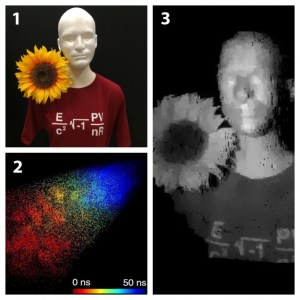
1) The scene, taken with a normal digital camera. Photo provided by Feihu Xu, MIT. 2) The raw data captured by the SPAD camera, about one photon per pixel as a point cloud. The significant background light and the coarse timing resolution of the SPAD camera are apparent. 3) The image formation algorithm produced this image of the scene. Graphic by Sara Cody

When you take a photo on a cloudy day with your average digital camera, the sensor detects trillions of photons. Photons, the elementary particles of light, strike different parts of the sensor in different quantities to form an image, with the standard four-by-six-inch photo boasting 1,200-by-1,800 pixels. Anyone who has attempted to take a photo at night or at a concert knows how difficult it can be to render a clear image in low light. However, in a recent study published in Nature Communications, one BU researcher has figured out a way to render an image while also measuring distances to the scene using about one photon per pixel.

“It’s natural to think of light intensity as a continuous quantity, but when you get down to very small amounts of light, then the underlying quantum nature of light becomes significant,” says Associate Professor Vivek Goyal (ECE). “When you use the right kind of mathematical modeling for the detection of individual photons, you can make the leap to forming images of useful quality from extremely small amounts of detected light.”

Goyal’s study, “Photon-Efficient Imaging with a Single-Photon Camera,” was a collaboration with researchers at MIT and Politecnico di Milano. It combined new image formation algorithms with the use of a single-photon camera to produce images from about one photon per pixel. The single-photon avalanche diode (SPAD) camera consisted of an array of 1,024 light-detecting elements, allowing the camera to make multiple measurements simultaneously to enable quicker, more efficient data acquisition.

The experimental setup uses infrared laser pulses to illuminate the scene the research team wanted to capture, which is also illuminated by an ordinary incandescent light bulb to accurately reproduce the condition of having a strong competing light source that could be present in a longer-range scenario. Both the uninformative background light and laser light reflected back to the SPAD camera, which recorded the raw photon data with each pulse of the laser. A computer algorithm analyzed the raw data and used it to form an image of the scene. The result is a reconstructed image, cobbled together from single particles of light per pixel.

The method introduced by Goyal’s team comes in the wake of their earlier first-ever demonstration of combined reflectivity and depth imaging from a single photon per pixel. The earlier work used a single detector element with much finer time resolution. The current work demonstrates that creating an image with a single-photon detector can be done more efficiently.

“We are trying to make low-light imaging systems more practical, by combining SPAD camera hardware with novel statistical algorithms,” says Dongeek Shin, the lead author of the publication and a PhD student of Goyal at MIT. “Achieving this quality of imaging with very few detected photons while using a SPAD camera had never been done before, so it’s a new accomplishment in having both extreme photon efficiency and fast, parallel acquisition with an array.”

Though single-photon detection technology may not be common in consumer products any time soon, Goyal thinks this opens exciting possibilities in long-range remote sensing, particularly in mapping and military applications, as well as applications such as self-driving cars where speed of acquisition is critical. Goyal and his collaborators plan to continue to improve their methods, with a number of future studies in the works to address issues that came up during experimentation, such as reducing the amount of “noise,” or grainy visual distortion.

“Being able to handle more noise will help us increase range and allow us to work in daylight conditions,” says Goyal. “We are also looking at other kinds of imaging we can do with a small number of detected particles, like fluorescence imaging and various types of microscopy.”


Boston University College of Engineering

Originally published on July 7, 2016

Appears on: BU ENG Website