Tumors sometimes feel different from regular cells, which is why doctors suggest performing self-exams to detect the presence of a lump in a breast or prostate. After noticing a gap in the knowledge exploring the unique mechanical properties of tumors such as hardness, one BU research team developed a computational model as a roadmap to help predict the effects of tumor mechanics on cells in a new study featured on the cover of Biophysical Journal.
“When we think of how cancer cells behave in various environments, it’s often associated with mechanical properties of the tumor, because tumors respond and behave differently compared to normal cells,” says Professor Muhammad Zaman (BME, MSE). “With better tools, we are starting to investigate what exactly is going on and what exactly is it about these different mechanical properties that causes tumors to be aggressive and invasive and how we can handle that in terms of treatment.”
Cells use complex signaling pathways to send and receive messages from other cells. Signaling pathways utilize protein molecules, which have matching receptors on their intended recipient and allow the cells to make sense of their environment and activate the performance of certain functions by turning genes on and off. YAP/TAZ is a set of protein molecules that bind to cell receptors that activate cell growth, proliferation and programmed death. Since studying the effects of YAP/TAZ in cancer is relatively uncharted territory, Zaman’s team sought to provide a fundamental guide to bridge the knowledge gap that exists and facilitate future exploration into YAP/TAZ.
“In this study, we are examining two aspects: the first is changing the outside properties of the cell and the second is seeing what happens on the inside of the cell when the outside changes” says Zaman. “We tried to correlate the two to see how they work together in terms of what turns on and off in the cell when its environment changes and connecting that with specific outcomes.”
Zaman’s study combines both experimentation and simulation, the former to establish benchmarks that can be used in a computer algorithm to create a simulation and the latter to make informed predictions for a variety of outcomes. In the laboratory, Zaman’s team identified signaling molecules to monitor the response of cells as their environment changed, essentially converting mechanical senses to biochemical signals within the cell. The cells were embedded in an extracellular matrix that was induced to stiffen, and Zaman’s team observed the changes that occurred with YAP/TAZ activity inside the cell. They found that stiffening the matrix directly affects the YAP/TAZ activity, which in turn promotes cancer progression.
Using this information, Zaman and his team developed an algorithm that allowed them to plug in this baseline data to make predictions on YAP/TAZ activity in response to the changing environment. They were able to verify the accuracy of their computational model by making predictions and performing the experiment in tandem to corroborate their calculations in a system of checks and balances. Using this model going forward, researchers can predict what lies ahead with the effect of YAP/TAZ on cancerous growth and metastasis, particularly in changing physical environments and in response to drug treatment. This map will allow researchers to branch off to explore new areas and develop a deeper understanding of how aggressive cancer works at a systems level, which has the potential to enable the development of more targeted approaches to treatment.
“I think that this is just the beginning,” says Zaman. “In this study, we tried to focus on the first of many questions that will hopefully open up the path toward fully understanding what is going on with this complicated, important set of pathways that are connecting extracellular properties with particularly adverse reactions from cancer cells.”
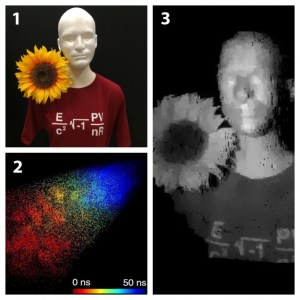
1) The scene, taken with a normal digital camera. Photo provided by Feihu Xu, MIT. 2) The raw data captured by the SPAD camera, about one photon per pixel as a point cloud. The significant background light and the coarse timing resolution of the SPAD camera are apparent. 3) The image formation algorithm produced this image of the scene. Graphic by Sara Cody
When you take a photo on a cloudy day with your average digital camera, the sensor detects trillions of photons. Photons, the elementary particles of light, strike different parts of the sensor in different quantities to form an image, with the standard four-by-six-inch photo boasting 1,200-by-1,800 pixels. Anyone who has attempted to take a photo at night or at a concert knows how difficult it can be to render a clear image in low light. However, in a recent study published in Nature Communications, one BU researcher has figured out a way to render an image while also measuring distances to the scene using about one photon per pixel.
“It’s natural to think of light intensity as a continuous quantity, but when you get down to very small amounts of light, then the underlying quantum nature of light becomes significant,” says Associate Professor Vivek Goyal (ECE). “When you use the right kind of mathematical modeling for the detection of individual photons, you can make the leap to forming images of useful quality from extremely small amounts of detected light.”
Goyal’s study, “Photon-Efficient Imaging with a Single-Photon Camera,” was a collaboration with researchers at MIT and Politecnico di Milano. It combined new image formation algorithms with the use of a single-photon camera to produce images from about one photon per pixel. The single-photon avalanche diode (SPAD) camera consisted of an array of 1,024 light-detecting elements, allowing the camera to make multiple measurements simultaneously to enable quicker, more efficient data acquisition.
The experimental setup uses infrared laser pulses to illuminate the scene the research team wanted to capture, which is also illuminated by an ordinary incandescent light bulb to accurately reproduce the condition of having a strong competing light source that could be present in a longer-range scenario. Both the uninformative background light and laser light reflected back to the SPAD camera, which recorded the raw photon data with each pulse of the laser. A computer algorithm analyzed the raw data and used it to form an image of the scene. The result is a reconstructed image, cobbled together from single particles of light per pixel.
“We are trying to make low-light imaging systems more practical, by combining SPAD camera hardware with novel statistical algorithms,” says Dongeek Shin, the lead author of the publication and a PhD student of Goyal at MIT. “Achieving this quality of imaging with very few detected photons while using a SPAD camera had never been done before, so it’s a new accomplishment in having both extreme photon efficiency and fast, parallel acquisition with an array.”
Though single-photon detection technology may not be common in consumer products any time soon, Goyal thinks this opens exciting possibilities in long-range remote sensing, particularly in mapping and military applications, as well as applications such as self-driving cars where speed of acquisition is critical. Goyal and his collaborators plan to continue to improve their methods, with a number of future studies in the works to address issues that came up during experimentation, such as reducing the amount of “noise,” or grainy visual distortion.
“Being able to handle more noise will help us increase range and allow us to work in daylight conditions,” says Goyal. “We are also looking at other kinds of imaging we can do with a small number of detected particles, like fluorescence imaging and various types of microscopy.”
A group of six BU students were the sole team from the U. S. to compete in the world’s largest supercomputing hackathon in Wuhan, China in April.
“Supercomputing uses very powerful hardware to run large and complex programs,” explains Hannah Gibson (ECE’17), a member of the BU Green Team who competed at the Asia Supercomputing Community Student Supercomputer Challenge. “It’s used in CGI for movies and for weather modeling-huge programs that require a lot of power. In the competition, the goal is to get the best performance with consideration for power and speed with the setup and software you designed and built.”
The competition featured 16 teams selected from 146 applicants that hailed from around the globe, from China and Russia to Hungary and Colombia. Each team provided a wish list of hardware to the sponsoring company, Inspur, and had to prepare software in advance to bring with them to the competition. Teams had four days total for the competition, including time for setup and installation.
“It was awesome being in a different country and seeing how our team stacked up to teams from all around the world,” says Wasim Khan (ECE’17), a member of the BU Green Team. “It was interesting to compete against other teams who come from schools that have supercomputing as a major and to see that we, an extracurricular student-run group, gave them a run for their money.”
In computing, performance is often measured by floating-point operations per second, or flops. The higher the number of flops, the better the computer performance and, in competition, the higher the score. Teams were given six applications, where they were tasked with rewriting portions of each program to work better on the target hardware, optimizing it to work on their architecture and complete real-world scientific workloads while obeying the competition constraint of 3,000 watts of power maximum.
Five of the applications were programmed to run on their own hardware setup, or cluster, to measure the number of flops it generated. The other application was run on the Tianhe-2, currently the world’s fastest supercomputer. The score was an algorithm that was based on the number of problem sets, or workloads, that were completed, with consideration for accuracy, timing and flops generated, if applicable. Awards were given to top scorers, “most innovative,” and “best overall.” In order to support the ASC mission to promote supercomputing outreach, teams were encouraged to tweet throughout the competition and the team with the most retweets was awarded the “most popular” designation.
“This is an impressive and highly motivated group of students who had to specify and acquire equipment, optimize the configurations, tune, and in some cases refactor the applications, and ultimately qualify for these competitions entirely of their own volition,” says Professor Martin Herbordt (ECE), who is the faculty advisor for the group. “It goes without saying that students learn a lot in their classes, but this type of professional, real-world experience that is self-guided takes their learning to a whole other level.”
The BU Green Team represented BU’s High Performance Computing (BUHPC) team, led by Winston Chen (CE’17) and Huy Lee (CS’16), is affiliated with BUILDs, the BU hackerspace that provides resources for students to undertake technology projects. Since their return from China, BUHPC is fundraising to attend the ISC Student Cluster Competition in Germany in June. In addition to competing, the event also includes professional development workshops and networking opportunities for students interested in the field of supercomputing.
The first named endowed lecture in the history of the College of Engineering, the Charles DeLisi Award and Distinguished Lecture recognizes faculty members with extraordinary records of well-cited scholarship, and outstanding alumni who have invented and mentored transformative technologies that impact our quality of life.
When Ünlü arrived at BU in 1992, he was inspired by the collegial interdisciplinary environment, which led him to apply his background in electrical engineering and electromagnetic waves to developing innovative methods for biological imaging and sensing. His presentation, peppered with video and audio messages from past students and mentors who have contributed to his work, chronicled his career path from graduate school to present day and centered on his current research in optical sensing and developing new bioimaging technologies that address the obstacles that currently plague the field of diagnostics.
“When you are trying to look at pathogens, the most distinguishing thing is to look at its genome, but obstacles like logistics and cost are prohibitive and drive scientists to find more compact and affordable ways that have the same functionality,” said Ünlü. “Single particle detection has been the physicist’s dream of addressing these issues, so that’s what we set out to explore.”
Synergy between Engineering and Medicine
In developing his optical detection technology, he drew inspiration from, of all places, a soap bubble. Specifically, the patterns of colors that develop on the surface when light is being reflected through it. According to Ünlü, the same interference phenomenon that gives rainbow colors to soap bubbles can also provide extremely high sensitivity as illustrated by the recent news on detection of gravity waves by optical interferometry.
“Most people don’t realize that just by calling out a certain color, you are making a measurement in the order of nanometers,” said Ünlü.
Ünlü extended this idea to develop his optical detection technology for single nanoscale particles, where the interference of light reflected from the sensor surface is modified by the presence of nanoparticles, producing a distinct signal that reveals the size of the particle that is otherwise not visible under a conventional microscope. Using this technology, Ünlü and his research team demonstrated label-free identification of some of the most deadly viruses in the world, including hemorrhagic viruses like Ebola, Lassa and Marburg, at a high sensitivity on par with state-of-the-art laboratory technologies. They have even been able to detect particles as small as individual protein and DNA molecules by labeling them with gold nanoparticles to provide sufficient visibility.
“Proteins are too small. We can’t see them directly so we decorate them with gold nanoparticles, which are not much bigger than the proteins themselves,” said Ünlü. “Decorating them with gold nanoparticles increases visibility of the molecules bound on the sensor surface, and we are able to count them in serum or whole blood.”
The resulting technological development in biomarker analysis that Ünlü has spearheaded is digital detection, an approach that counts single molecules, which provides resolution and sensitivity beyond the reach of ensemble measurements. Digital detection for medical diagnostics not only provides very high sensitivity, but also has the potential of making the most advanced molecular diagnostic tools broadly accessible at low cost.
Digital detection captures images of individual viruses in real time
“Optical interference is a very powerful sensing technique,” summed up Ünlü. “With this biological imaging technology, we can detect single particles if they are large enough on the nanoscale, such as viruses, and see them directly. If they are proteins or DNA molecules we have to label them with a small, metallic nanoparticle to see them.”
In terms of next steps, Ünlü and his team will continue to refine the technology for commercialization, including applying some of these findings to produce microarray chips that provide calibration and quality control in industry. His laboratory will continue to work on advancing the technology further and gaining a deeper understanding of the theoretical basis in order to enhance the methodology. In particular, they are looking into applying the technology to such areas as real-time DNA detection, rare mutations, and most recently a project to characterize viruses that target cancer cells.
To conclude his presentation, Ünlü expressed his appreciation of the support he received from the College to foster collaboration, and to his students, mentors and family who helped him along the way.
“I’m very thankful to Boston University for providing an incredibly rich environment for research because there are no barriers between disciplines,” said Ünlü. “Multidisciplinary innovation is the driving force of discovering new things and making society better, and ultimately that is my motivation.”
The DeLisi Lecture continues the College’s annual Distinguished Lecture Series, initiated in 2008, which has honored several senior faculty members. The previous recipients are Professors John Baillieul, (ME,SE), Malvin Teich (ECE) (Emeritus), Irving Bigio (BME), Theodore Moustakas (ECE, MSE), H. Steven Colburn (BME), Thomas Bifano (ME, MSE), Christos Cassandras (ECE, SE) and Mark Grinstaff (BME, MSE, Chemistry, MED).

 Sara Cody